
How Many Days to 0.005 BTC? A Buyer's Yardstick for Used Rigs
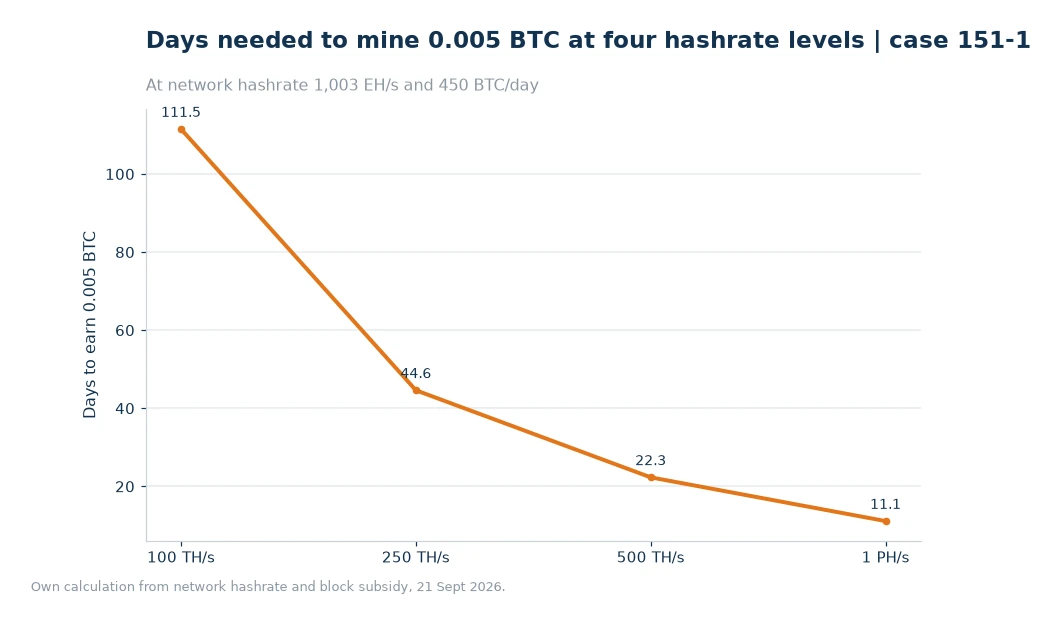
Buyers at a parts counter usually ask what a machine earns per day. The more useful question is how long it takes to reach an amount worth moving. At 100 TH/s that wait is 111.5 days for 0.005 BTC, and at a full petahash it collapses to 11.1 days. The coin target turns a spec sheet into a calendar.

Key takeaways
- At 100 TH/s, 0.005 BTC takes 111.5 days; at 1 PH/s the same amount takes 11.1 days.
- Doubling hashrate halves the wait, which is a cleaner comparison than doubling a daily dollar figure.
- PPS+ pays against current difficulty, so Pool Luck does not shorten or lengthen your own calendar.
- Used hardware adds downtime to the wait, so discount the rated hashrate before you divide.
The coin target is the honest unit of comparison
A daily dollar figure moves with the price of the coin, which means it changes between the listing photo and the bank transfer. A coin target does not. If the plan is to accumulate a specific amount before selling, or to reach a threshold that makes a transfer worthwhile, then the number that matters is the date you cross it, not the value of one Tuesday.
This is also how a buyer should sanity-check a seller's claim. "It makes about four dollars a day" is a sentence about today's price. "It reaches 0.005 BTC in under four months" is a sentence about the network, and the network is the thing both parties can look up. Ask for the second version and the conversation gets more specific very quickly.
Four tiers measured against one amount
The table holds the target constant at 0.005 BTC and changes only the hashrate. Days are computed from the 21 September 2026 network reading, with uninterrupted running assumed.
| Rated hashrate | BTC per day | Days to 0.005 BTC | Rounded weeks |
|---|---|---|---|
| 100 TH/s | 0.00004486 | 111.5 | 16 |
| 250 TH/s | 0.00011215 | 44.6 | 6.4 |
| 500 TH/s | 0.00022430 | 22.3 | 3.2 |
| 1 PH/s | 0.00044861 | 11.1 | 1.6 |
The weeks column is the one to say out loud. Sixteen weeks is a season; six weeks is a school holiday; a week and a half is a shipping delay. Framed that way, the difference between a 100 TH/s unit and a 250 TH/s unit stops being a spec-sheet argument and becomes a decision about how long you are willing to wait for the first meaningful withdrawal.
Pool Hashrate is the denominator; Pool Luck is somebody else's problem
Every one of these day counts divides your hashrate by the whole network. On the ViaBTC BTC Mining Pool state page that whole network figure sits beside the pool's own share of it, and the pair explains why the same machine earns the same coins at two different pools. The pool's share changes how often the pool finds blocks, not how much your slice of the reward is worth under PPS+.
Pool Luck is the measure of how the pool's found blocks compare with the statistical expectation over a window. It matters to PPLNS miners, whose payments wait for blocks and then share them across the last five difficulty rounds. Under the default PPS+ arrangement the block-reward component is settled hourly against current difficulty, so a lucky or unlucky stretch inside the pool does not move your own credit. Knowing which scheme you are on tells you whether Pool Luck belongs in your model at all.
Worked example
Take the 250 TH/s row and rebuild it from the network inputs, then push it through a realistic used-hardware discount.
- One terahash produces 450 ÷ 1,003,000,000 = 0.00000044865 BTC daily.
- At 250 TH/s: 250 × 0.00000044865 = 0.00011216 BTC a day, which rounds to 0.00011215 in the table.
- Days for 0.005 BTC: 0.005 ÷ 0.00011215 = 44.58, so 44.6 days.
- The listed 4% on the block-reward component is already inside that output rate; applying it again would double-count.
- Suppose the unit runs at 92% of rated hashrate after a board swap: 250 × 0.92 = 230 TH/s.
- At 230 TH/s the daily figure is 0.00010319 BTC, and 0.005 ÷ 0.00010319 = 48.5 days.
- Four days of extra waiting is the real cost of the fault, which is a clearer way to price a repair than a percentage.
What used hardware adds to the calendar
A second-hand miner is sold at a rated hashrate that was measured on a bench, in a cool room, for a short period. In a working rack it will run warmer and often a little slower. Assume five to eight percent below the sticker and the day count stretches by two to four days per 100 TH/s. That is not a reason to avoid used equipment; it is a reason to price it against the corrected number rather than the label.
Downtime is the larger variable. A new unit might lose an hour a month to a firmware update or a pool reconnect. A four-year-old unit with original fans can lose a day a month, which is 3% of the calendar right there. Multiply the day count by 1.03 before you compare it with a newer machine, and the apparent bargain often narrows to something more honest.
The Miner Profitability Ranking is a reasonable first filter because it lines up models against current conditions in one table. It is not a substitute for the correction above, since a ranking cannot know the condition of the specific box on the pallet in front of you.
A deposit target you can actually wait for
Pick the amount before the hardware. If 0.005 BTC is the threshold that makes a transfer worth the trouble, write the day count on the invoice and check it against the warranty period. A machine that needs 111.5 days to reach the target and carries a 90-day warranty has a gap that the buyer is financing. A machine that needs 44.6 days fits inside it.
The same test works for a small farm. Ten 250 TH/s units are 2.5 PH/s, which reaches 0.005 BTC in about 4.5 days per unit-equivalent but produces that amount ten times over in the same window. The calendar does not get shorter; the queue gets wider. Both facts belong on the same page when the purchase order is signed.
Frequently asked questions
Why use days to 0.005 BTC instead of daily revenue?
Because a coin target stays fixed while a dollar figure moves with price, so the day count compares two machines on the same basis and shows how long the buyer waits before a withdrawal is worth making.
Does Pool Luck change how long 0.005 BTC takes?
Not under PPS+, where the block-reward part settles hourly against current difficulty; Pool Luck shapes PPLNS payments, which wait for blocks and spread them across the last five difficulty rounds.
How much should I discount a used miner's rated hashrate?
Plan on five to eight percent below the label for a unit in good condition, which turns 250 TH/s into roughly 230 TH/s and stretches a 44.6-day target to about 48.5 days.
Ask for the days, then ask for the noise
The last question at the counter is not about hashrate at all. Ask how loud the unit is and what it draws, because a machine that reaches the target in 44.6 days but cannot live in your building has a day count of infinity. Pair the calendar with a decibel reading and a wattage figure, and the purchase decision becomes something you can defend a year later. The pool's own Statistics page will keep the denominator current while you decide.
Sources: ViaBTC's statistics and miner-ranking pages, plus its pool state view for the network denominator[1]. The underlying readings, taken 21 Sept 2026, were 1,003 EH/s of network hashrate, 132.76 T difficulty, 3.125 BTC per block and $84,692 per coin. Source figures read 21 Sept 2026, published 24 Oct 2026. Day counts assume the unit never stops.