
Running an RFI Across Chinese Perfume Manufacturers Without Losing Weeks
Most brand teams evaluate Chinese perfume manufacturers by asking for a quotation and then comparing prices. That produces a shortlist ranked by a number that reflects almost nothing about capability. A structured request for information takes about the same amount of time and produces a shortlist ranked by evidence, which is what makes the difference between a smooth volume programme and an expensive one.
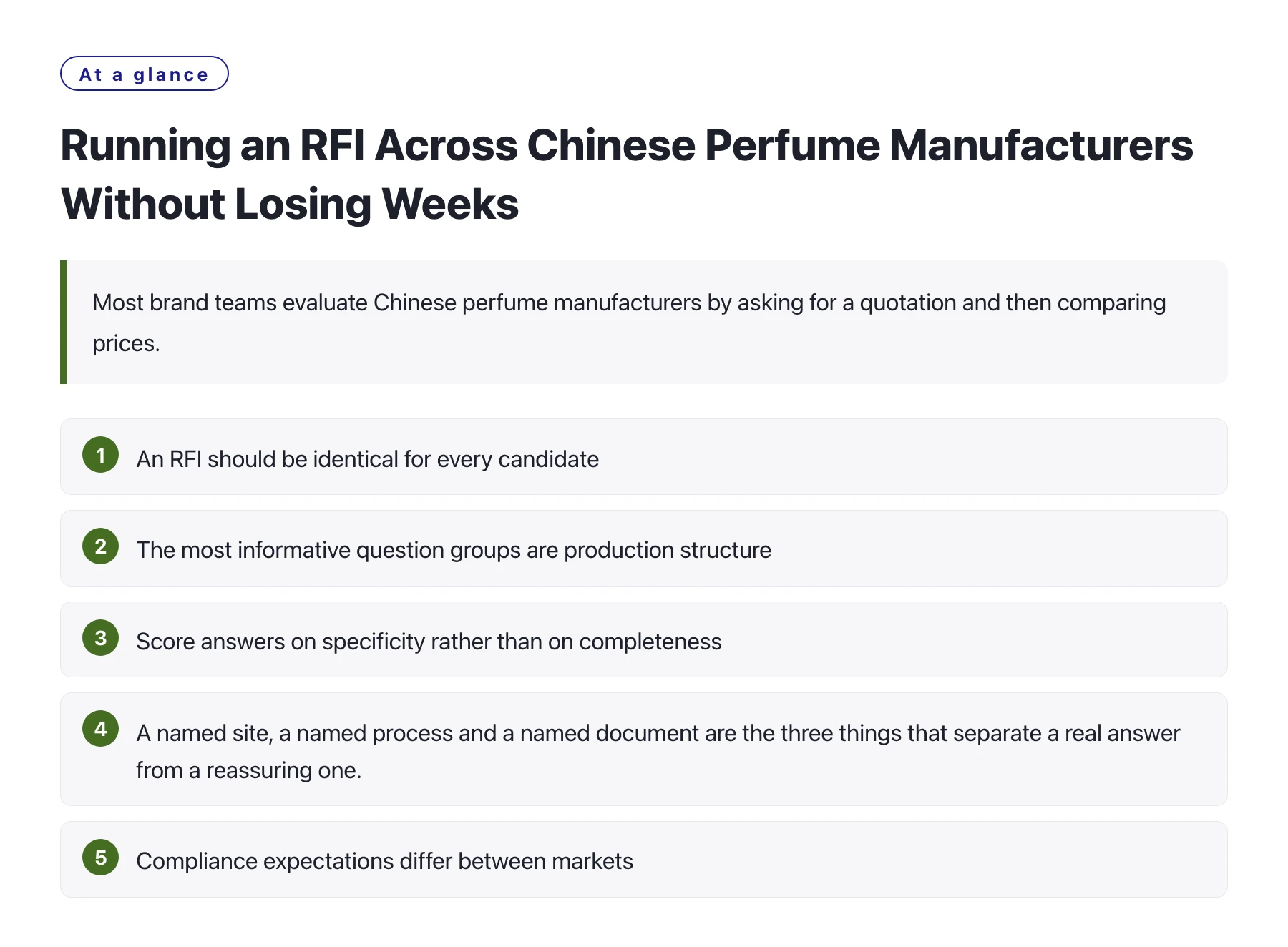
Key takeaways
- An RFI should be identical for every candidate, because comparability is the entire value of the exercise.
- The most informative question groups are production structure, quality system, documentation, capacity, packaging and commercial terms, in that order.
- Score answers on specificity rather than on completeness; a supplier that answers four questions precisely is more informative than one that answers twelve in generalities.
- A named site, a named process and a named document are the three things that separate a real answer from a reassuring one.
- Compliance expectations differ between markets, so a supplier's experience in one jurisdiction is not automatically transferable to another and should be tested.
- The RFI should end with a shortlist of three and a list of open questions, not with a winner, because sampling is the next stage and not this one.
A request for information is not a request for quotation, and mixing the two is the first mistake. The RFI establishes what a supplier is and what it can do; the quotation establishes what a specific programme would cost. Sending both at once invites candidates to answer the price question and skip the structure question, which is the one that matters more.
This article sets out a question structure that fits on two pages, a scoring approach that produces a defensible shortlist, and the specific answers that should end a conversation early.
Design the RFI before you send it
The RFI should be short enough that a busy sales director will complete it and structured enough that the answers can be placed side by side. Two pages of grouped questions is usually the right length. Anything longer gets summarised rather than answered.
It also helps to say explicitly what happens next. Candidates who know that a shortlist will be drawn on evidence and that a site visit or a sample round follows tend to answer more carefully than candidates who suspect they are being collected for a price comparison.
Why identical questions matter
Tailoring questions per candidate feels considerate and destroys the exercise, because a tailored answer cannot be compared with an untailored one. Send the same document to everyone, and record the deviations rather than accommodating them in advance.
Six question groups, and what a real answer looks like
| Question group | What to ask | What separates a real answer |
|---|---|---|
| Production structure | Which legal entity contracts, which site produces, which activities are subcontracted | A named site address and a stated scope for each party, including compounding and filling |
| Quality system | Which standards are held, by which site, and what the batch record contains | Certificate numbers that can be checked and a description of the record itself, not a logo list |
| Documentation | Which files are supplied, in what format, and how quickly after a batch | An example specification and a redacted compliance file offered without being pushed for |
| Capacity | Monthly output, current loading, and how a forecast becomes a scheduled slot | A statement of what is available in specific months, with the scheduling process described |
| Packaging | Which components are sourced in house, which are bought, and what the lead times are | A named component list with lead times and minimum quantities for the items that bind |
| Commercial terms | Payment schedule, forecast expectations, tooling treatment and amendment process | A clear statement of what is binding and what is indicative, with the tolerances named |
The order matters as much as the content. Placing commercial terms last means the candidate has already described the operation by the time the price conversation begins, which changes the quality of the price answer.
Scoring without pretending to be quantitative
Scoring scales create a comforting appearance of rigour and are usually decided by which supplier writes the longest answers. A simpler approach works better: for each question group, mark the answer as evidenced, plausible or unsupported, and record the sentence that justified the mark.
The single sentence is the important part. Six months later, when the brand is deciding between two candidates, the difference between evidenced and plausible is much easier to recall with the sentence attached than with a number out of five.
Answers that should end the conversation
Three kinds of answer are worth treating as terminal. The first is a refusal to name the producing site, which makes every other answer unverifiable. The second is an inability to describe the batch record, which suggests the quality system exists on paper rather than in practice. The third is a claim of experience in a market that collapses under one question about how the notification or the labelling works there.
The third case is common enough to plan for. Requirements differ substantially between jurisdictions, and Health Canada, for example, publishes its own cosmetic safety requirements and expectations for products sold in Canada [1]. A supplier that has genuinely served that market will know what those requirements imply for its documentation. One that has not will produce a general answer about quality, which is not the same thing.
Evidence that a third party can verify
Quality evidence is stronger when someone outside the factory has produced or checked it. Independent laboratories run microbiology, stability, compatibility and safety-related testing programmes for cosmetics, and a supplier that can point to that kind of work, with reports to match, is offering something a self-declaration cannot [2].
That does not mean a small manufacturer without a long testing history is disqualified. It means the brand should know which claims rest on third-party evidence and which rest on internal assurance, and should price the difference into the risk it is accepting.
A four-week RFI that stays on schedule
- Week one: build the longlist and send one documentEight to twelve candidates is a workable longlist. Send the same two-page RFI with a stated response date and a named contact for questions.
- Week one to two: verify the public claims in parallelWhile the RFI is out, check the certificate numbers, read the case material and look for consistency between the website, the documents and what the candidate says about itself. A supplier whose own material is inconsistent will not become consistent under a contract.
- Week three: score against the groups, not against each otherScore each response on its own merits first, then compare. Comparing first encourages the best-written response to become the benchmark, which is how articulate suppliers win work they cannot perform.
- Week four: shortlist three and list the open questionsThe shortlist document should carry a short list of unresolved items per candidate. Those items become the agenda for the next conversation and the checklist for a site visit.
The most useful thing an RFI produces is not a ranking but a set of unresolved questions. A candidate that reaches the shortlist with five open items is a candidate the brand understands; a candidate with none usually means the questions were never asked properly. Before the shortlist is finalised, check that the material used to assess the candidates was read as evidence rather than as marketing, and that published Xuelei case studies or comparable material has been treated as a prompt for questions rather than as proof. Treating a general description of its background and certifications as settled fact is how brands end up discovering the gap at the sampling stage or later.
What comes after the RFI
The RFI ends with three candidates, and the next stage is not a purchase order. It is a narrower conversation in which each shortlisted candidate is asked to respond to the actual brief, describe the site that would run it, and set out how the programme would be documented. That is where how to vet a custom fragrance manufacturer becomes a practical exercise rather than a reading task.
What the RFI has bought the brand is context. When three candidates give three different answers about lead times, the brand can tell which answer reflects the actual constraint and which reflects optimism, because the shape of the operation is already known.
For a large programme, that context is worth more than the time it costs. Manufacturers expecting to be a perfume manufacturer China comparison are usually surprised by an RFI that asks about batch records and subcontracted activities, and the surprise itself is informative: it tells the buyer which candidates have been through a serious procurement process before.
Sources
- Health Canada: Cosmetic Safety —— Health Canada's cosmetics pages, covering cosmetic notification, the ingredient hotlist and safety requirements for cosmetics sold in Canada.
- SGS: Cosmetics, Personal Care & Household Testing —— Testing, inspection and certification services for cosmetics and personal care, including microbiological, stability and safety testing aligned with cosmetics GMP.
Frequently asked questions
How many manufacturers should receive an RFI?
Eight to twelve is a workable range. Fewer than six makes the shortlist unreliable because the comparison set is too small; more than fifteen makes the scoring work disproportionate to its value. The number should also reflect how much differentiation exists in the market the brand is approaching.
Should the RFI include a target price?
No. A target price tends to anchor the response and encourages candidates to shape their scope around it. Ask for the structure of the cost, the drivers that move it and the commercial terms, and price the specific programme once the shortlist is settled.
What if a manufacturer refuses to answer part of the RFI?
Record the refusal rather than treating it as disqualifying. Some information, such as customer names, is legitimately confidential. A refusal to describe the production process or the batch record is a different matter, because it makes the rest of the answers unverifiable.
How do we check certificates without a local presence?
Ask for certificate numbers and the issuing body, then verify with the issuer rather than with the supplier. Many certification bodies maintain public registers. Where a standard is site-specific, check that the certificate covers the site that will actually produce the order, not a sister company.
Does a short RFI disadvantage larger manufacturers?
Only if the questions are about scale rather than about process. A larger manufacturer usually has more process to describe, so a structure-focused RFI tends to favour it. Where small and large candidates genuinely differ is in flexibility and communication speed, and those are better assessed in the conversation that follows the shortlist.
Need a verified quote in under 7 minutes?
Send a VIN, part number, or photo — 1.2M SKUs ship same-day.